|
|
 |
|
|
|
|
 |
|
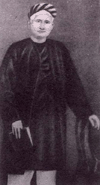
Bankim Chandra
|
Bankim
Chandra belonged to a Brahmin family of Hooghly district. He began his
education in Midnapore. In 1856 he joined Presidency College and
became one of the first graduates of the Calcutta University.
Afterwards he sat for a law examination in 1869 and had a brilliant
academic carrier. He was a man of refined culture and good taste . He
was brought up in the atmosphere of racialism in Bengal. His
personality brought him into contact with distinguished men, but his
deep sense of self-respect & mastery of facts made him planned
into bitter controversies with his superiors.His famous novel
Anandmath was published in 1882. In 1874 he composed "Bande
Matram" which was sung at the second session of Indian National
Congress in 1886. He realised that English education could not be
neglected but felt that the western ideas could penetrate the masses
through vernacular literature,which would bring out a social
regeneration. As his concept of Nationilasation was wider, he has been
referred to as the "Prophet of Indian Nationalism".
It is fitting that the most impressive new township in Calcutta should be named after Dr. Bidhanchandra Ray (1882-1962), for he was by general consent the maker of modern West Bengal, being Chief Minister of the truncated and ravaged state from 1948 until his death. His first claim to fame, however, is as a physician of almost legendary powers, one of India’s leading doctors in his day. He entered politics in 1023; he was also Mayor of Calcutta from 1931 –1933 Vice-Chancellor of Calcutta University from 1942 to 1944.
His Greatest achievement as Chief Minister was surely the founding of the industrial city of Durgapur. In the Calcutta area, he conceived and began work on Salt Lake Reclamation Scheme and the Kalayani Township. He also set up public schemes and corporations to provide basic services, like the Calcutta State Transport Corporation and the Calcutta Milk Supply, and masterminded the expansion of the hospital and university system in the city.
The list of projects and institutions stemming directly and indirectly from Bidhanchandra would be endless. This itself indicates his grasp of the total planning process and the interrelated nature of West Bengal’s problems and requirements. The overriding problem was of course the agonizing aftermath of the Partition; and his schemes were frequently oriented to allow maximum employment and economic benefit to the East Bengal refugees.
The problems of West Bengal outlasted Bidhanchandra; but had it not been for him, they might have engulfed the state.
Through his vision and his immense authority as an administrator, he endowed Calcutta and West Bengal with certain crucial systems and assets that survived a long period of turmoil and stagnation and now, though radically modified at times, can serve as the basis for future growth. |
|
A | B | C | D | E | F | G | H | I | J | K | L | M | N | O | P | Q | R | S | T | U | V | W | X | Y | Z
home | about us | services | contact us | press releases | site map | feedback |
Site Contents Copyright © 2000